Projects
There are people who conduct geofiction by
themselves, developping their countries on their own. Mostly they can
fascinatingly tell stories about their geos. There are also people who
enjoy having their countries interact. These countries have to be in
each other's neighbourhood, so that they can be reached by sea or by
land. Mostly the last option is a reason for various developments, but
that is exactly the point of interaction. Every country has its own
possibilities and limitations, depending on its location, size, number
of inhabitants, the degree of affluence, culture, nature, etc.
Interaction Project is a somewhat large word for a cooperational association of a number of geoficticians. Their countries are on the same planet (a ficticious planet or simply on earth), so these countries can border each other, have relations with each other, conduct wars, in short: influence each other. Writing or telling stories about your country can be fun, but writing about somebody else's country can be even more fun! The various countries of an interaction project together form one new, larger geo (a continent, a treaty organization or a planet). The countries have a history of their own, but the greater area has one too, because events occur not only within the countries themselves, but also between the countries. Just as in reality on earth.
For each country there are events that can only occur, because there are other countries. Apart from the country's own development it has to react on the things that happen in other countries, or the things other countries do. Without other countries export or war is almost impossible. And because everybody can influence the whole project, from his or her own country, a history for the whole project slowly takes shape, creating a richer history for every country within the project. In an interaction project it is therefore impossible to be entirely on your own, because your neighbours can cause events influencing your country. For some people, this way of conducting geofiction needs some time to get used to. But it is also challenging, because you can interfere in the businesses of other people's countries. Mostly rules are necessary to determine how much influence is tolerable and acceptable, but when all this is settled, and when the participants have a healthy dose of humour, the maps can be drawn and the interaction can begin. The interaction can be quite serious, when the project and its countries are realistic (with diplomatic treaties, sport, culture, politics, economics etc.), but it can also turn out to be quite humourful, with parodies on (existing) names, forms of government, schandals and other developments. Often this form of interactive geofiction is used to mock reality.
Within the Dutch
Geofiction Association the following projects exist, or existed:
the League of Geofictional States (AGL, from the Dutch
abbreviation Aardse Geofictieve Liga). This is an international
organization of political, cultural and economical cooperation between
five countries located at various places on earth. The AGL was founded
on March 2nd, 1986 and has known a varying number of memberstates and a
varying degree of activity. The present memberstates (as of September
13th, 2009) are the republic of Chimor, the republic of Île de Romanhe,
the kingdom of Insulantis, the kingdom of Issel, the kingdom of
Karstonia, the kingdom of
Kronenburg, the kingdom of the Mii-Isles, the republic of Norland, the
republic of São Antonio and the kingdom of Seppia. São Antonio will
leave the organisation as of January 2010.
Check the
AGL-website for more information (this site is in Dutch).
Aota. The Aota-project was
launched in 2004 and has three participants, who each have a continent
of their own, together with a common continent, which is the ancient
home of a large part of the civilizations on the other three continents.
The goal is simple: developing a planet with the aim to conduct
interaction. At this moment Aota is in a phase of development, during
which each participant has the opportunity to write a thematic article
about his continent for the project's magazine, which is published every
three months.
Aota has no website (yet).
Nywal. Started in 2011 by some
of the Thalassa participants, Nywal is a much smaller scale project. The
setting is some small countries located on mountain tops of a larger
continent that ended up under water after the sea level rose some 3000
years ago.
More information can be found on the project's wiki:
http://www.geopoeia.net/wiki/Nywal/en.
Pangeo. This humourful project was situated on the continent of Caire on an unknown planet. It was launched on September 1st, 1996 and was ended at December 31st, 2006. Pangeo is probably the most succesful of all DGA projects, having existed for slightly more than ten years. The challenge of Pangeo was a large shortage of metals; in a setting comparable with earth's period 1899 - 1930 (in a country in Western Europe or North America), this caused a number of remarkable differences. An Industrial Revolution like earth had in the nineteenth century, had not been present on Caire, or at least in a different manner. Although humour was an important aspect of this project, much attention was also payed to the developping of alternative weapons, machinery, railways and other things that use a large amount of metal on earth.
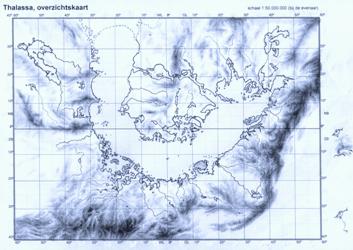 Thalassa. Thalassa was launched in early 2007
and ended in 2010 as the successor-project to Pangeo.
'Successor-project' is probably not a good designation, by the way:
although some of the participants of Pangeo now participate in Thalassa,
and the set of rules that applied for Pangeo, has been largely adopted
for use in the Thalassa project, it is the intention that the new
project will differ from its predecessor. An important rule that was
dropped for Thalassa, was the lack of metals: there are enough metals in
the countries around the Thalassa, although the variants of metal are
more or less equally divided among the countries. The project is
situated around an inland sea (the 'Thalassa'), which is surrounded by a
huge continent, on a planet where it's generally colder than on earth.
It is possible that there are more inland seas on the other hemisphere,
but those are inaccessible due to the climate, which makes large parts
of the continent uninhabitable because of extreme cold or heat. When the
project was launched, the technical development was compareable with
earth's Western Europe or North America around the year 1836.
Thalassa. Thalassa was launched in early 2007
and ended in 2010 as the successor-project to Pangeo.
'Successor-project' is probably not a good designation, by the way:
although some of the participants of Pangeo now participate in Thalassa,
and the set of rules that applied for Pangeo, has been largely adopted
for use in the Thalassa project, it is the intention that the new
project will differ from its predecessor. An important rule that was
dropped for Thalassa, was the lack of metals: there are enough metals in
the countries around the Thalassa, although the variants of metal are
more or less equally divided among the countries. The project is
situated around an inland sea (the 'Thalassa'), which is surrounded by a
huge continent, on a planet where it's generally colder than on earth.
It is possible that there are more inland seas on the other hemisphere,
but those are inaccessible due to the climate, which makes large parts
of the continent uninhabitable because of extreme cold or heat. When the
project was launched, the technical development was compareable with
earth's Western Europe or North America around the year 1836.
Check the
Thalassa-site for more information (the site is in Dutch).
The Alliance of Fictional States (VFS, after Verbond van Fictieve Staten in Dutch). The VFS was founded in 2006 to arrange cultural exchanges between the memberstates. The secretary of the alliance, which coordinates the alliance's activities, is located in the Mård-Institute in the capital of the kingdom of Karstonia, Marckfontänn. The Mård-Institute was founded on June 1st, 1990 and was named after the former Karstonian minister Alexander Mård. The institute conducts international research after the relations between (fictional) countries. President of the institute, who is also Secretary-General of the alliance, is Vöi Jüüksed.
Other projects were Geoforum, Geopolis, Honua Nei and Secran.